> ## Documentation Index
> Fetch the complete documentation index at: https://docs.dubot.ai/llms.txt
> Use this file to discover all available pages before exploring further.
# Build and publish a Wizard
> Configure a Wizard and make one governed placement available to users
Use a Wizard when you need a configured assistant in your product. A Wizard has one placement.
## Before you start
* Add any workspace knowledge the Wizard should retrieve.
* Create the capabilities it should use. Only a Skill capability can carry actions.
* Choose a safe product URL where you can preview the placement in Test.
## Configure the Wizard
Enter the Wizard name and goal description. Add an opening message, launcher label, input
placeholder, quick prompts, and file-upload setting when the customer experience needs them.
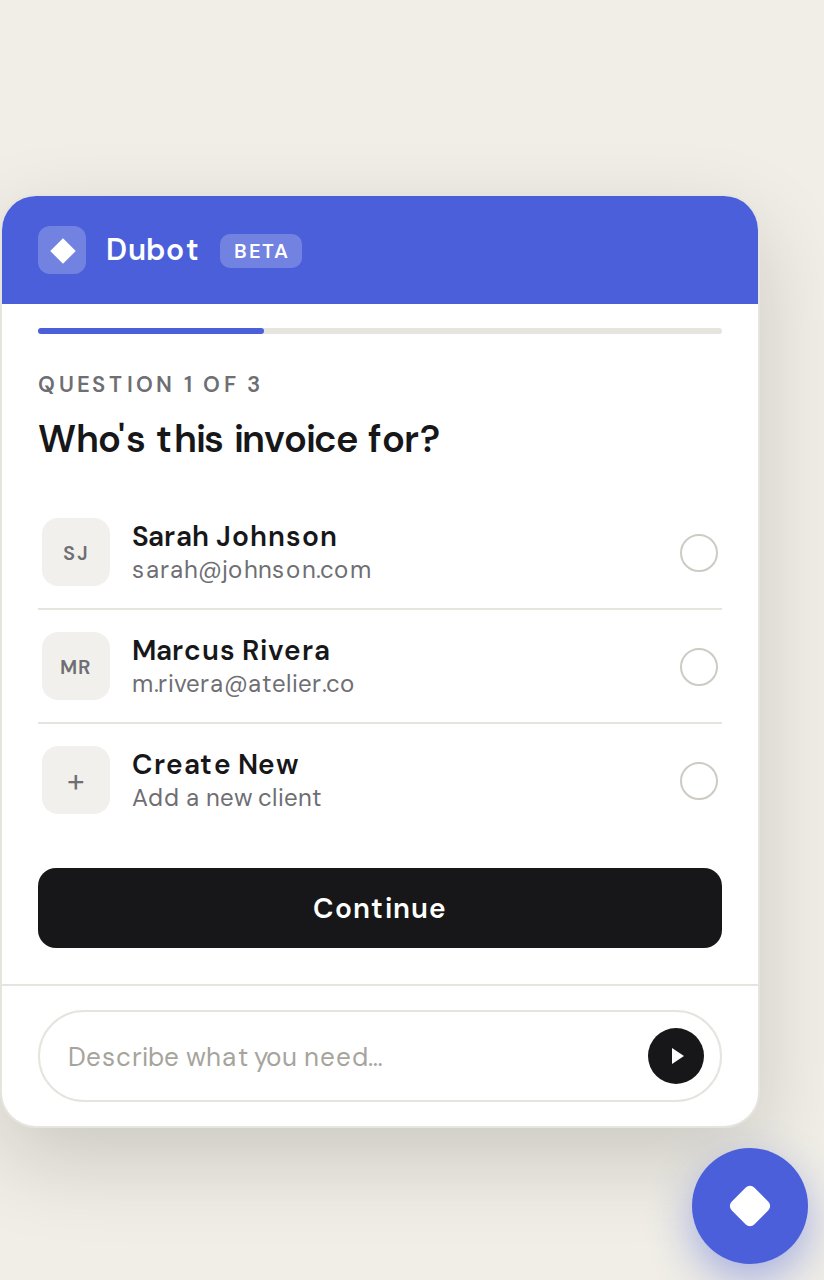
Select **Bubble**, **Inline**, **Sidebar**, or **Fullscreen**. A Wizard has one placement. Create
a separate Wizard when the same behavior needs a different placement or targeting rule.
Add include or exclude URL rules. Inline also requires a valid CSS selector for its mount
point. A valid selector that is not present renders nothing; an invalid selector blocks a
usable placement.
Choose the model and reasoning budget, attach capabilities, and decide whether optional
capabilities are embedded or available on demand for this Wizard.
Turn on direct knowledge when the Wizard should retrieve from the workspace corpus. Choose the
entire knowledge base or selected articles. This setting is independent of its capabilities.
Add the required standing instructions that steer this Wizard on top of its capabilities and
page context. The editor limits the booster to 2,000 characters.
Select **Create wizard**. The detail page then owns its draft, publish, version, and Activity
lifecycle.
 ## Test and publish
Select **Save draft**. Test the saved configuration in the Test experience, including identity,
page context, placement, knowledge, and attached capabilities. Fix validation errors or missing
dependencies before publishing.
Select **Publish** and review the dependency check. Production reads published versions only. A
published Wizard is still subject to the host's identity, page, permissions, and supported actions.
Actions are available only through an attached published Skill capability. A Wizard placement is
separate from the Resource Center, whose reserved Agent has no placement.
## Expected result
The Wizard appears only on its intended pages and placement, completes the representative Test
conversation with the expected knowledge and capabilities, and produces a matching Production
conversation after publishing.
See [Preview Dubot with the browser extension](/guides/preview-with-browser-extension) for a Test
session, [Create and publish a capability](/guides/create-capability) for reusable behavior, and
[Recover or roll back configuration](/operate/recovery) if a live placement must be removed.
## Test and publish
Select **Save draft**. Test the saved configuration in the Test experience, including identity,
page context, placement, knowledge, and attached capabilities. Fix validation errors or missing
dependencies before publishing.
Select **Publish** and review the dependency check. Production reads published versions only. A
published Wizard is still subject to the host's identity, page, permissions, and supported actions.
Actions are available only through an attached published Skill capability. A Wizard placement is
separate from the Resource Center, whose reserved Agent has no placement.
## Expected result
The Wizard appears only on its intended pages and placement, completes the representative Test
conversation with the expected knowledge and capabilities, and produces a matching Production
conversation after publishing.
See [Preview Dubot with the browser extension](/guides/preview-with-browser-extension) for a Test
session, [Create and publish a capability](/guides/create-capability) for reusable behavior, and
[Recover or roll back configuration](/operate/recovery) if a live placement must be removed.