> ## Documentation Index
> Fetch the complete documentation index at: https://docs.dubot.ai/llms.txt
> Use this file to discover all available pages before exploring further.
# Understand analytics and activity
> Move from workspace trends to the conversation, run, or call that produced them
Dubot separates the workspace-level Overview from the activity attached to each product object.
Use Overview to find a pattern, then open the relevant Wizard, Guidance theme, Resource Center
conversation, action, or capability to diagnose it.
## Start with Overview
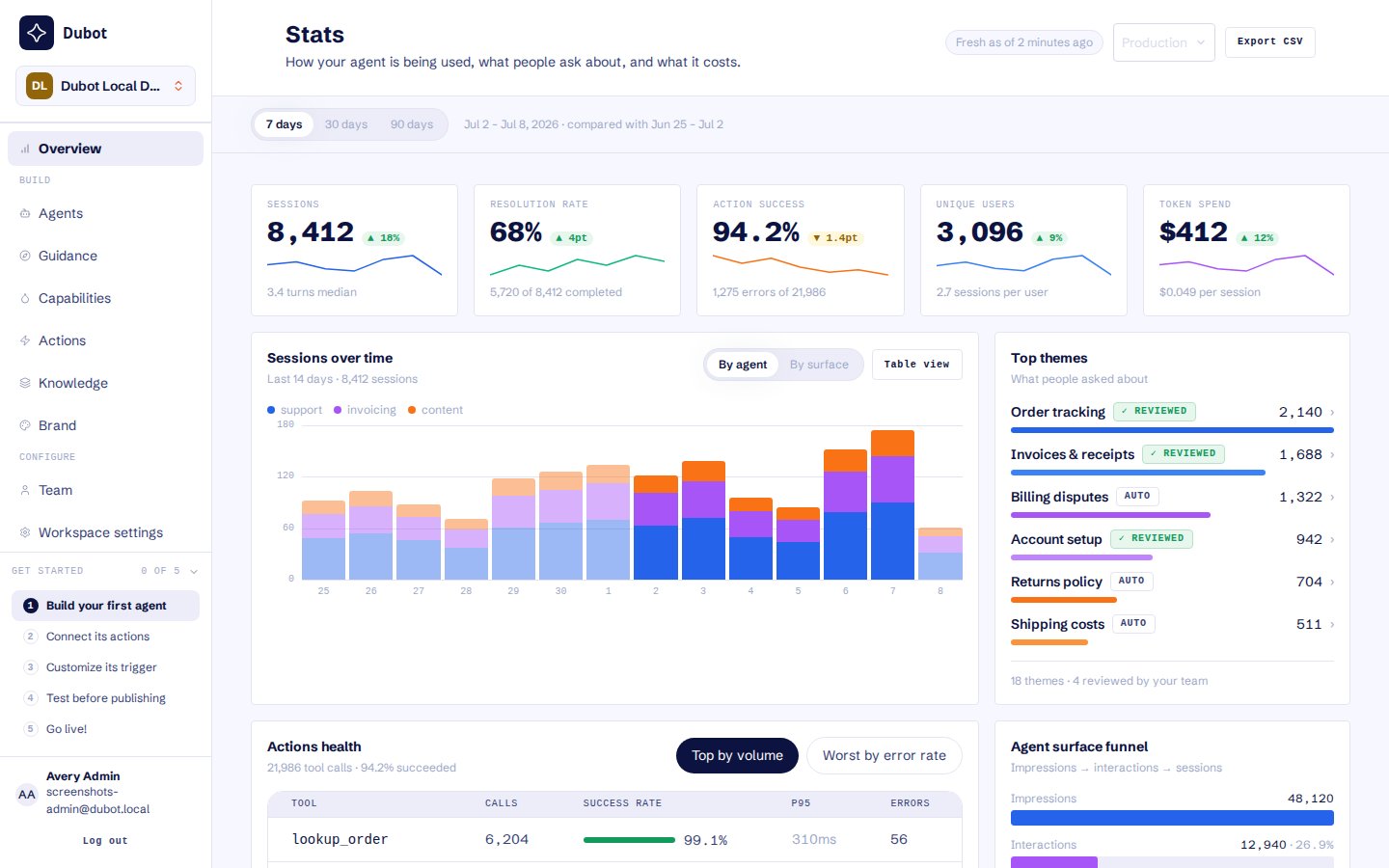
Open **Overview** and choose 7, 30, or 90 days. Depending on the features enabled and available
data, the page can show:
* sessions, median turns, resolution rate, and unique users;
* action success, errors, latency, and action health;
* sessions over time and common themes;
* the agent-surface funnel;
* Guidance performance; and
* token use and estimated spend.
Overview currently reports Production activity. A cached or unavailable panel is not the same as
zero activity.
 ## Open the supporting activity
| Start here | Inspect next | Use it to answer |
| ------------------------------- | --------------------------------------------------------------------- | ----------------------------------------------------------------------- |
| **Wizard → Activity** | Conversation and transcript | What the customer asked, what the agent used, and how the session ended |
| **Guidance → Analytics** | Theme, session, and run timeline | Which journeys complete, stop, error, or go quiet, and at which step |
| **Resource Center → Analytics** | Opens, viewers, card clicks, searches, chats, and conversation detail | Whether people open the panel and which help path they use |
| **Action → Activity** | Calls, outcome, user, agent, duration, and failure detail | Whether a specific operation is reliable and available |
| **Capability → Activity** | Calls from the actions in that capability | Whether the attached bundle is being used successfully |
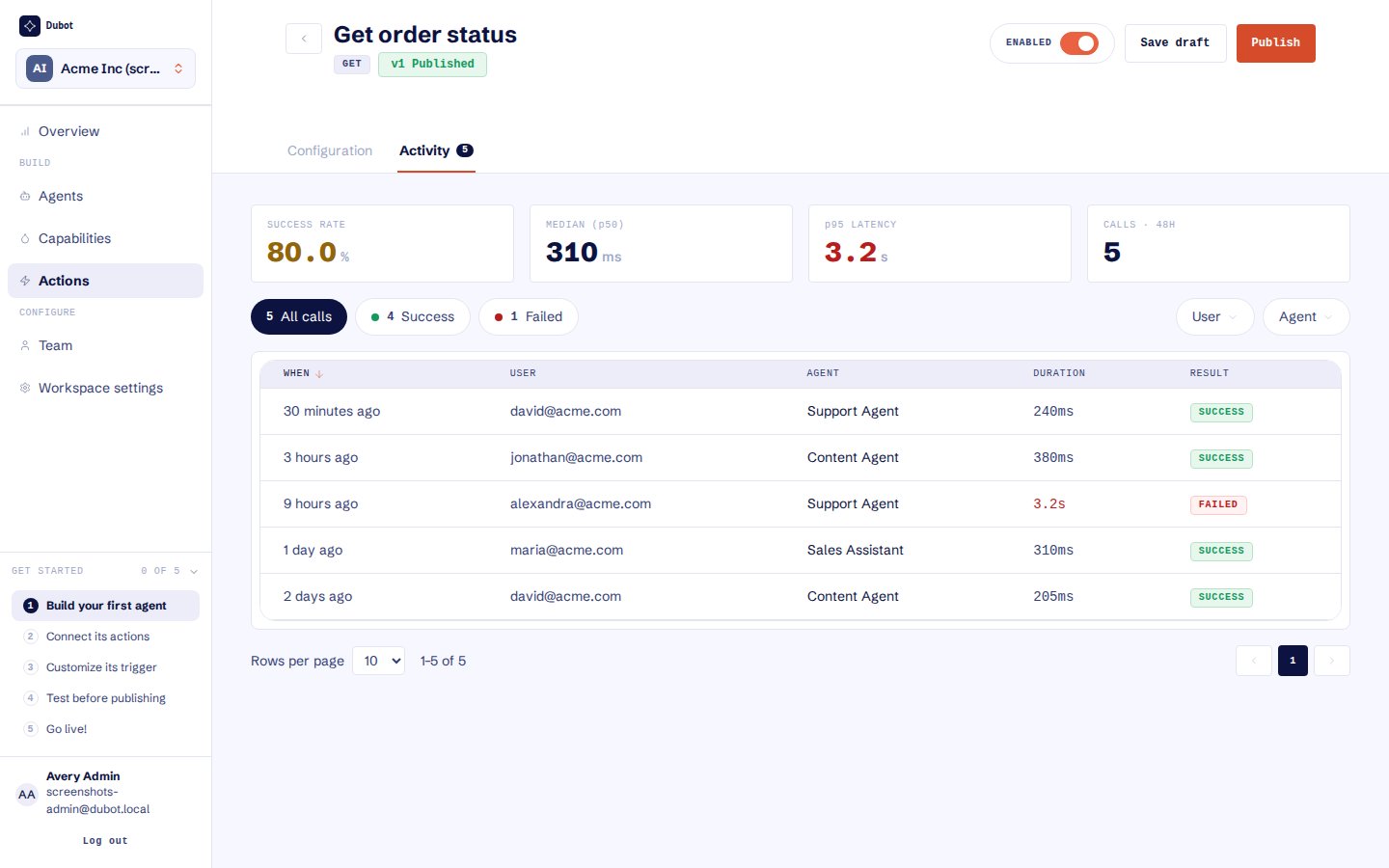
For an action, open **Activity** to compare its success rate, latency, and recent calls. Filter the
list before opening the failed or slow record that needs investigation.
## Open the supporting activity
| Start here | Inspect next | Use it to answer |
| ------------------------------- | --------------------------------------------------------------------- | ----------------------------------------------------------------------- |
| **Wizard → Activity** | Conversation and transcript | What the customer asked, what the agent used, and how the session ended |
| **Guidance → Analytics** | Theme, session, and run timeline | Which journeys complete, stop, error, or go quiet, and at which step |
| **Resource Center → Analytics** | Opens, viewers, card clicks, searches, chats, and conversation detail | Whether people open the panel and which help path they use |
| **Action → Activity** | Calls, outcome, user, agent, duration, and failure detail | Whether a specific operation is reliable and available |
| **Capability → Activity** | Calls from the actions in that capability | Whether the attached bundle is being used successfully |
For an action, open **Activity** to compare its success rate, latency, and recent calls. Filter the
list before opening the failed or slow record that needs investigation.
 ## Diagnose before changing configuration
Use the date range, theme ranking, action-health table, or feature metrics to find a repeated
outcome. Do not optimize around a single unusual session.
Read the full transcript, run timeline, or action call. Confirm the user, agent, page, duration,
and result belong to the behavior you are investigating.
Check whether the activity came from the live published configuration or a later draft tested
by an operator. Draft testing is not customer adoption.
Update the smallest responsible object, test it, and publish deliberately. Revisit the same
activity view after enough comparable sessions have accumulated.
## Interpret the evidence carefully
* A rendered surface is not the same as a started session.
* A tool request is not the same as a successful customer-side operation.
* A completed assistant turn is not necessarily a resolved customer outcome.
* A draft tested by an operator is not customer adoption.
* Per-theme Guidance counts can overlap because one run may carry several themes.
* Cached or unavailable analytics panels should not be treated as zero.
Guidance outcomes include completed, stopped, error, abandoned, and active. Review the run timeline
before changing a guide based only on its aggregate completion rate.
Resource Center Analytics does not retain the customer's search or question text as an aggregate
metric. Ask conversation detail is available separately to authorized workspace users.
Product activity is operational evidence, not a contractual security or compliance audit log.
Confirm retention, export, access, and compliance requirements from the current customer
agreement and security materials.
See [Preview and publish safely](/operate/publishing) for the version model. When the evidence
identifies a live configuration problem, use
[Recover or roll back configuration](/operate/recovery).
## Diagnose before changing configuration
Use the date range, theme ranking, action-health table, or feature metrics to find a repeated
outcome. Do not optimize around a single unusual session.
Read the full transcript, run timeline, or action call. Confirm the user, agent, page, duration,
and result belong to the behavior you are investigating.
Check whether the activity came from the live published configuration or a later draft tested
by an operator. Draft testing is not customer adoption.
Update the smallest responsible object, test it, and publish deliberately. Revisit the same
activity view after enough comparable sessions have accumulated.
## Interpret the evidence carefully
* A rendered surface is not the same as a started session.
* A tool request is not the same as a successful customer-side operation.
* A completed assistant turn is not necessarily a resolved customer outcome.
* A draft tested by an operator is not customer adoption.
* Per-theme Guidance counts can overlap because one run may carry several themes.
* Cached or unavailable analytics panels should not be treated as zero.
Guidance outcomes include completed, stopped, error, abandoned, and active. Review the run timeline
before changing a guide based only on its aggregate completion rate.
Resource Center Analytics does not retain the customer's search or question text as an aggregate
metric. Ask conversation detail is available separately to authorized workspace users.
Product activity is operational evidence, not a contractual security or compliance audit log.
Confirm retention, export, access, and compliance requirements from the current customer
agreement and security materials.
See [Preview and publish safely](/operate/publishing) for the version model. When the evidence
identifies a live configuration problem, use
[Recover or roll back configuration](/operate/recovery).