> ## Documentation Index
> Fetch the complete documentation index at: https://docs.dubot.ai/llms.txt
> Use this file to discover all available pages before exploring further.
# SDK actions
> Register host callbacks and understand the Session API execution boundary
## Register client-side callbacks
Use client-side callbacks for operations that belong to the current page, such as navigation or
updating in-memory application state.
```js theme={null}
const actions = [
{
tool_id: 'clientside_callback_open_billing',
input_schema: {
type: 'object',
properties: {},
additionalProperties: false,
},
execute: async () => {
router.navigate('/settings/billing');
return { opened: true };
},
},
];
await window.Dubot.init({
userId: currentUser.id,
identityToken,
actions,
});
```
The callback must also have a reviewed, published governance envelope in Dubot and be reachable
through a Skill capability attached to the wizard.
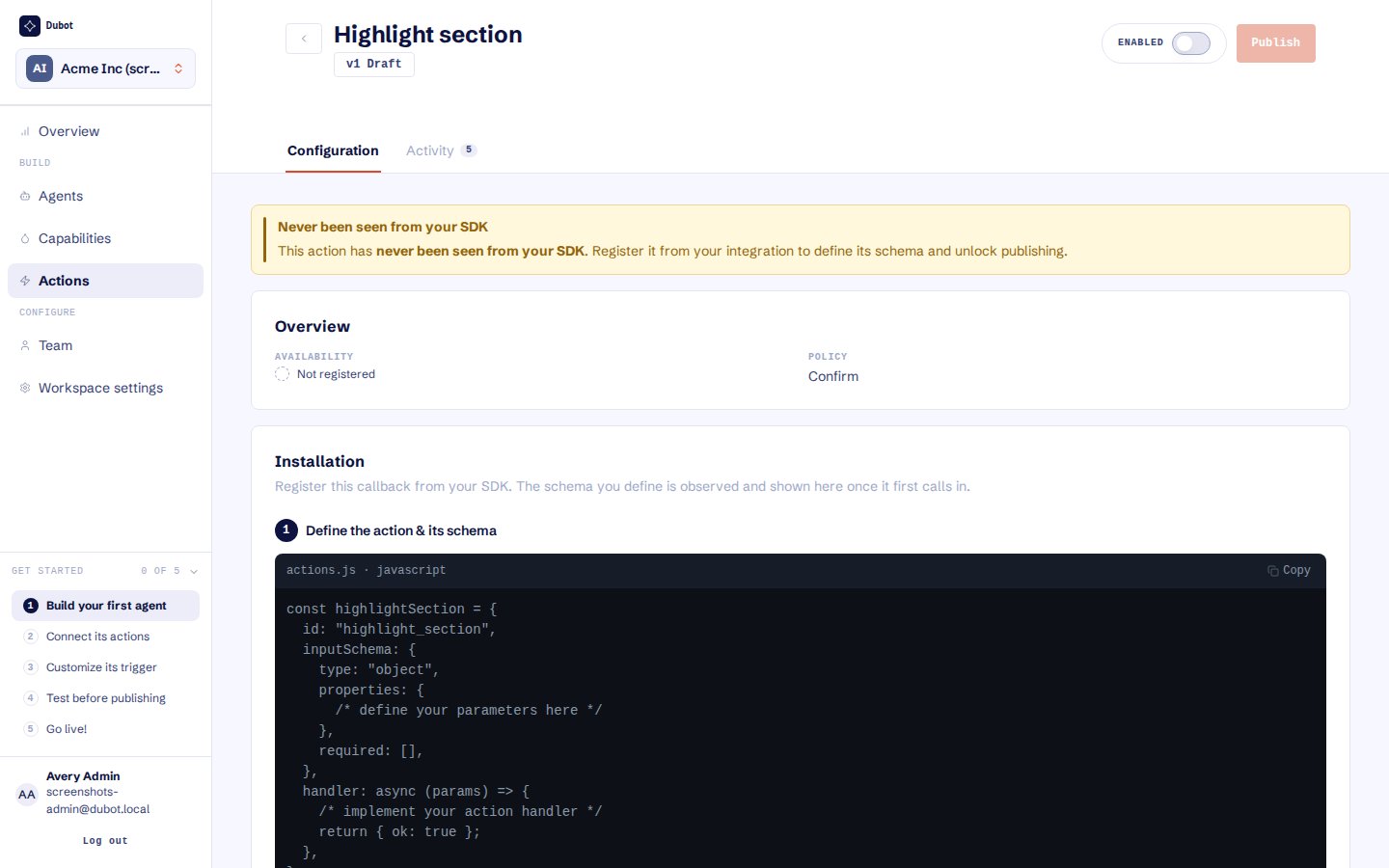
The action detail shows whether the callback has been observed from the SDK. Registration supplies
the schema and unlocks publishing; an unregistered callback remains unavailable at runtime.
 ## Replace callbacks when page state changes
`setActions()` uses full-set replacement semantics. Pass every callback that should be available
after the call.
```js theme={null}
window.Dubot.setActions([
openBillingAction,
currentInvoice ? markInvoiceReviewedAction : null,
].filter(Boolean));
```
A callback omitted from the new set becomes unavailable to the assistant on the next turn.
## Execute Session API actions
The customer-owned Session API executor is currently delivered and reviewed during integration;
it is not yet a stable self-service public API. Confirm its request and registry contract with
Dubot before implementing the first authenticated operation.
Session API actions are authored in Dubot with a method, endpoint, input schema, response mask,
risk, and execution policy. The runtime boundary is deliberate:
```text theme={null}
SDK requests { tool_id, input }
-> customer-owned first-party executor resolves the published registry
-> executor uses the application's existing authentication
-> customer API returns a result
-> response mask reduces the result
-> SDK continues the assistant turn
```
The SDK bundle does not receive an arbitrary destination from the model and should not own the
customer application's credentials. Dubot provides the first-party executor pattern during
integration so the customer's engineering team can review and ship it with the application.
## Confirmation and outcomes
Every action has an `auto` or `confirm` execution policy.
* Chat-originated confirms render in the wizard.
* End-user MCP confirms render in the page action toast.
* A decline returns a declined outcome without invoking the operation.
* Errors return a bounded failure result and appear in action activity.
* Response masks limit which returned fields reach the assistant.
## Resource Center callbacks are separate
A static Resource Center card can run a host callback without advertising that callback as an
assistant tool:
```js theme={null}
await window.Dubot.init({
userId: currentUser.id,
identityToken,
resourceCenterCallbacks: [
{
id: 'clientside_callback_contact_support',
execute: () => supportMessenger.open(),
},
],
});
```
`resourceCenterCallbacks` and `actions` are intentionally separate registries.
## Replace callbacks when page state changes
`setActions()` uses full-set replacement semantics. Pass every callback that should be available
after the call.
```js theme={null}
window.Dubot.setActions([
openBillingAction,
currentInvoice ? markInvoiceReviewedAction : null,
].filter(Boolean));
```
A callback omitted from the new set becomes unavailable to the assistant on the next turn.
## Execute Session API actions
The customer-owned Session API executor is currently delivered and reviewed during integration;
it is not yet a stable self-service public API. Confirm its request and registry contract with
Dubot before implementing the first authenticated operation.
Session API actions are authored in Dubot with a method, endpoint, input schema, response mask,
risk, and execution policy. The runtime boundary is deliberate:
```text theme={null}
SDK requests { tool_id, input }
-> customer-owned first-party executor resolves the published registry
-> executor uses the application's existing authentication
-> customer API returns a result
-> response mask reduces the result
-> SDK continues the assistant turn
```
The SDK bundle does not receive an arbitrary destination from the model and should not own the
customer application's credentials. Dubot provides the first-party executor pattern during
integration so the customer's engineering team can review and ship it with the application.
## Confirmation and outcomes
Every action has an `auto` or `confirm` execution policy.
* Chat-originated confirms render in the wizard.
* End-user MCP confirms render in the page action toast.
* A decline returns a declined outcome without invoking the operation.
* Errors return a bounded failure result and appear in action activity.
* Response masks limit which returned fields reach the assistant.
## Resource Center callbacks are separate
A static Resource Center card can run a host callback without advertising that callback as an
assistant tool:
```js theme={null}
await window.Dubot.init({
userId: currentUser.id,
identityToken,
resourceCenterCallbacks: [
{
id: 'clientside_callback_contact_support',
execute: () => supportMessenger.open(),
},
],
});
```
`resourceCenterCallbacks` and `actions` are intentionally separate registries.